
The Music Makers
On Pure Imagination and the Curious After-life of a Poem

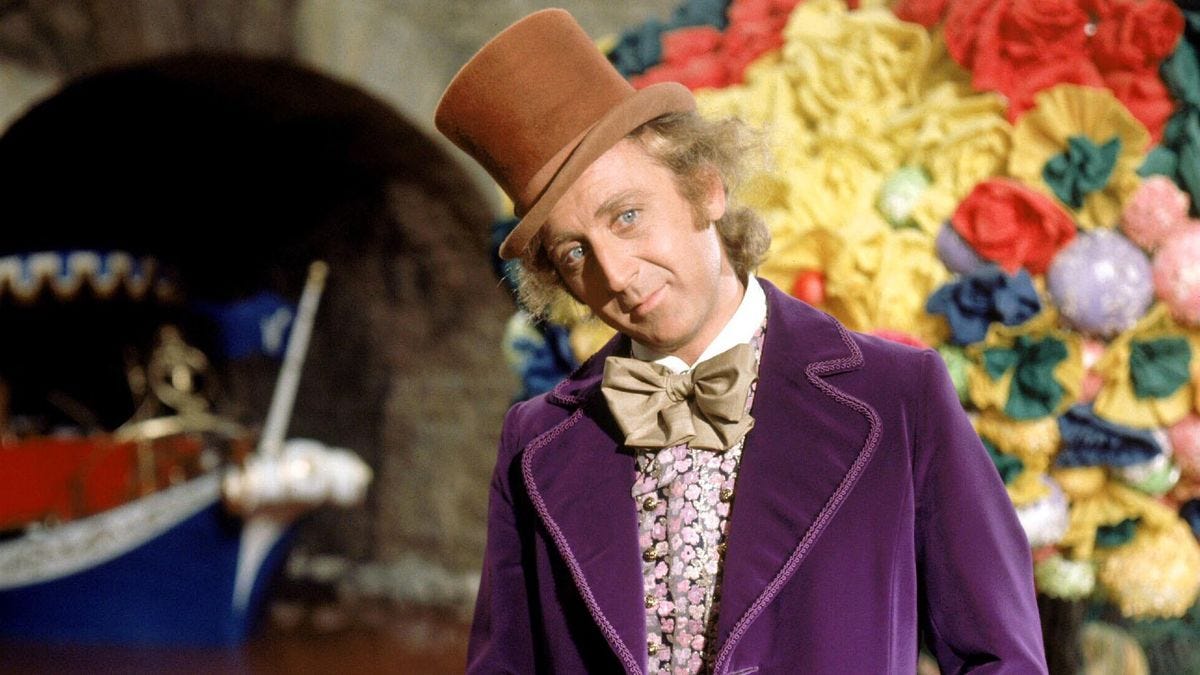
Watching the 1971 movie of Charlie and the Chocolate Factory with my children recently - a VHS favourite of my own childhood and far better than the clangorous Depp/Burton remake - I was struck by something in the dialogue I somehow hadn’t properly noticed before. Interesting to note that although Roald Dahl is credited with writing the screenplay for the film based on his own story, apparently he didn’t come up with the goods promptly enough and the American screenwriter David Seltzer was called in to complete the script, including much of the dialogue.
This makes sense, because the dialogue in the film is considerably more zippy and witty than in the book, which in spite of its reputation as a classic of children’s literature is hardly memorable for its dialogue or indeed for the rest of its prose, more controversial now for its use of the kind of prejudicial, derogative language no contemporary author would use (“great big greedy nincompoop” is one mild example.) You can see how Selzer was needed to pep up and energise the dialogue, making it come alive within a Hollywood-style movie context but also within the mouths of actors who are mostly American. Dahl’s old-fashioned schoolboyish English peppered with insults, put-downs and twee neologisms wouldn’t have worked so well within the film version, directed by the American Mel Stuart, which ends up being an amalgam of offsetting cultural registers and unsettling tonal shifts, often lending a surreal, absurdist quality to the movie. Shot in an austere-looking Munich (certainly an eastern European setting rather than an American one) and based on a comedic English book which satirises its American characters (Violet Beauregarde, Mike Teavee and their parents), the cast is almost entirely American except for the characters of Veruca Salt and her father, played by Julie Cole and Roy Kinnear. (In fact a British comedian of the 1970s, Tim Brooke-Taylor of The Goodies, makes a cameo appearance as an exasperated computer operator.)
It’s in Gene Wilder’s ludic, ambivalent portrayal of Willy Wonka that Selzer’s dialogue really shines through. The element which surprised me in my recent viewing was the sheer number of literary references the film contains: Wonka’s exchanges with the children and their families are studded with lines of English poetry which invariably operate as puzzling non sequiturs, flummoxing the nosey vulgarity of the parents. I won’t list all the allusions here but, for example, there are half a dozen allusions to Shakespeare, including “Springtime, the only pretty ring time” from As You Like It, “Where is fancy bred, in the heart or in the head?” from The Merchant of Venice and, in the remarkable final scene, “So shines a good deed in a weary world” (slightly twisted from “naughty world”, again from Merchant of Venice).
There’s also Keats’ “A thing of beauty is a joy forever” (the opening line of Endymion); a line from the anthology piece Sea Fever by John Masefield, “All I ask is a tall ship and a star to sail her by” and even an Oscar Wilde bon mot from The Importance of Being Earnest, “The suspense is terrible. I hope it lasts.” Also in keeping with the film’s comic bravura is a line from Ogden Nash, “Candy is dandy, but liquor is quicker” (in fact this is a whole four-line poem entitled ‘Reflections on Ice-Breaking’).
In the strange levity the film left me with, I began to see Willy Wonka in a different light. Rather than just the playful, eccentric ringmaster of the Chocolate Factory, the fanciful inventor of his own enclosed world and its fantastical confectionery, (even the trickster and conjuror emphasised in the recent Timothee Chalamet off-shoot Wonka), could he be read as a poet-figure in himself, a Wildean dandy as his velvet purple suit and frilly cravat might suggest? Suddenly the song which Wonka croons when the children and their parents first enter the Chocolate Room - “Come with me, and you’ll be/In a world of Pure Imagination” - took on a new resonance. It seemed to link back to the Romantics and their worship of the Imagination and its transformative power, set against the mercantile, avaricious cynicism of the outside world. Wonka’s song is ushering his guests into a sphere of imaginative liberty and sensory blurring such as we discover in poetry, a polymorphic zone in which the harmful impacts of contemporary life on the children might be tested and challenged.
Could Wonka even be seen as a Virgilian guide escorting Charlie and the others through an underworld whose circles embody four (if not Seven) of the Deadly Sins, with each child receiving the “poetic justice” appropriate to their vice - Gluttony (Augustus Gloop), Pride (Violet Beauregarde), Greed (Veruca Salt), Sloth/Wrath (Mike Teavee). The nightmarish ‘Boat Ride’ sequence sees the hallucinogenic magic of the Chocolate Room suddenly veer into a bad trip, perhaps prefigured by the earlier song ‘Candy Man’ with its familiar 70’s drug hint. The speeded-up boat ride seems like a spiralling catabasis, that descent into the underworld which was a recurrent trope in ancient mythology, notably in the myth of the archetypal poet Orpheus when he ventures into Hades. The lyrics of the song creepily intoned by Wilder hint at this interpretation - “Are the fires of Hell a-glowing?/ Is the grisly reaper mowing?”
Some further lines of poetry recited by Willy a little later not only seemed remarkably familiar to me, they also reinforced this sense of the narrative momentum of the film revolving around counterbalancing forces of, on the one hand, poetry and imagination, and on the other, moral transgression and penitence. “We are the music-makers, and we are the dreamers of dreams”. Where did I know this from, was it Wilde again - surely something from the 19th century?
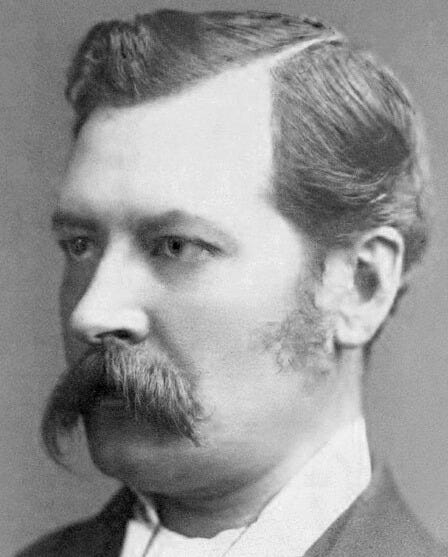
When I looked up the lines, I discovered the minor Victorian poet Arthur O’Shaughnessy (1844 -81), a friend of Rossetti and the other Pre-Raphaelites but also an eminent herpetologist after whom four species of lizards are named. “We are the music-makers” is the opening of his most famous poem, ‘Ode’, published in 1874 and later to appear in Palgrave’s Golden Treasury. While the rest of the poem seems a precursor of Yeats’s plaintive, Celtic Twilight period both in diction and metre, it hardly rises above the generic and Parnassian (in Hopkins’ sense), deservedly consigned to the status of enjoyable minor poem endowed on it by TS Eliot in the 1957 essay What is Minor Poetry? However FR Leavis, in New Bearings in English Poetry (1932), is less forgiving, holding up O’Shaughnessy’s ‘Ode’ as an example of “the poetical”, that species of ethereal, post-Romantic verse that was primarily “preoccupied with the creation of a dream-world”. He also calls O’Shaughnessy “a poetaster”, which seems unduly harsh.
But in fact it’s through music that the lines recited by Wonka have not only survived beyond their status as poetry but have also taken on a strange and wonderful after-life of their own, morphing into a hauntological echo of the movie in which memory and “pure imagination”, nostalgia and hedonism, coalesce. It was Elgar who first set O’Shaughnessy’s ‘Ode’ to music in his choral work The Music Makers (first performed in 1912), but what links the poem’s opening as it appears in Charlie and the Chocolate Factory with contemporary music is its repeated use as a sample in a multitude of dance tracks. In the endlessly concatenating patterns of sample culture that emerged during the 90s, it became a referential/reverential nod to other producers, a signature motif flagging auditory kinships between disparate musical forms, with the unifying, utopian vision that lay behind much dance music inherent in the idea of musical dreamers who could yet build cities and redeem humankind.
From two key starting points, Aphex Twin’s ‘We are the Music Makers’ on the pivotal album Selected Ambient Works 85-92 and 808 State’s ‘Nefatiti’ on ex:el (1991), the sample of Wilder’s voice rapidly developed into a trope employed across genres during the 90s and beyond, encompassing hiphop, techno, drum n bass and trance. I’m working on a Spotify playlist to be posted in Comments below but here’s something to listen to in the meantime. There is also, by the way, a “highly active and widely recognised community of musicians, producers and songwriters hosted on Reddit” called r/WeAreTheMusicMakers, one of the biggest on the internet. Not bad for a few lines of Victorian poetry and a children’s movie about a chocolate factory.