
The surface/ breaks
On Jorie Graham and Ecopoetry

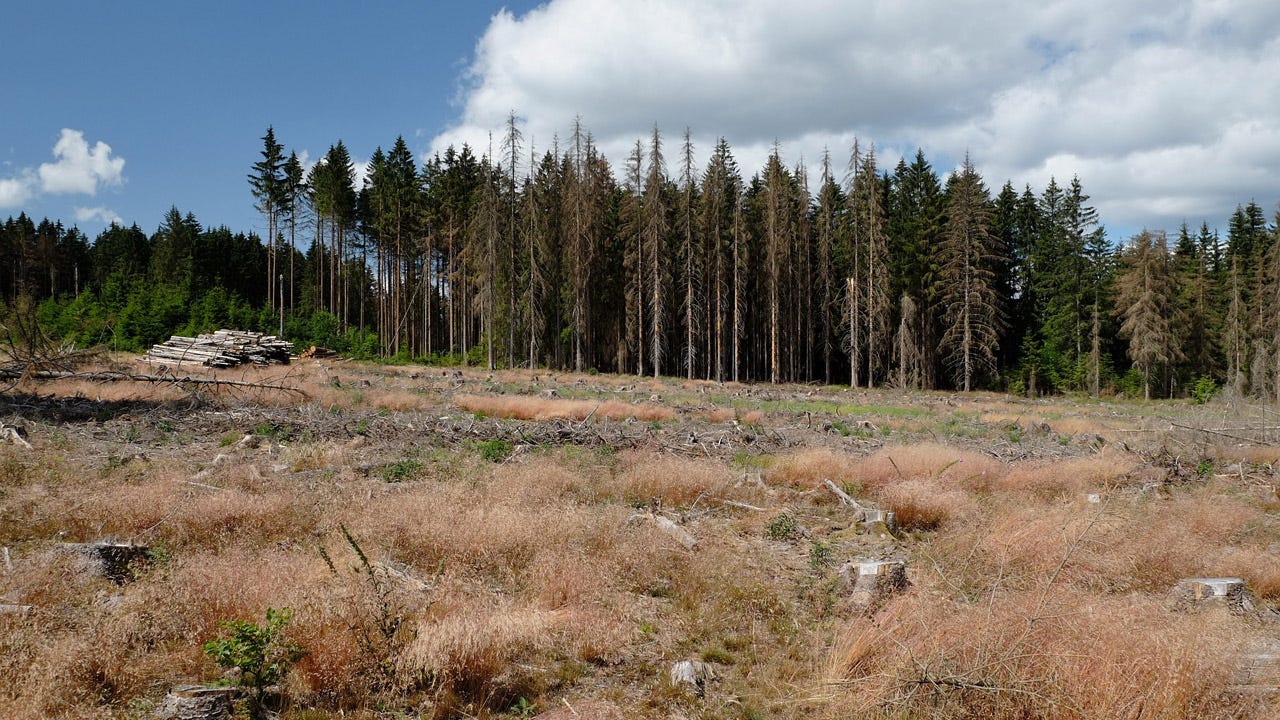
In the woods nature has fallen still. The birds are all but silent. The parched grass resembles old, frazzled straw and the trees have a drawn, worn-out look, hardly stirring in the breeze. The chestnuts have turned prematurely orange and brown, seasons out of sync. You turn on the news to see wildfires burning uncontrollably across Europe, causing mass deforestation and loss of life. The seas are warming, depleting some forms of marine life and causing strange shifts in others, such as the “octopus bloom” happening off the southern coast. Climate change seems to be transforming us as our infrastructure and living spaces buckle under the heat, built for more temperate weather. Can we really be longing for the summer rains we used to bemoan?
The fact that we are living in a state of ecological crisis whose effects are impacting on the world around us right now and not in some undefined dystopic future has become an undeniable reality, even though plenty (including Trump and other world leaders) continue to deny it. In fact, globally, the political consensus has shuffled backwards from previous commitments to green initiatives rather than moved decisively forward. It seems more urgent than ever for writers and artists to respond to this extreme situation, to communicate the overwhelming importance of confronting the crisis we find ourselves in. Yet the most effective way to do this through the medium of poetry feels uncertain, especially in the face of what Peter Larkin calls “current recalcitrant conditions”.
Has the status of ecopoetry (alongside its related discipline ecocriticism) also wavered within recent literary discourse? Neither, of course, are recent developments. Both terms were first employed by the American writer William Ruekert in his influential essay ‘Literature and Ecology: An Experiment in Ecocriticism’ (1978), citing the poets Gary Snyder and Robert Bly as earlier, seminal advocates of this approach. The contemporary British poet and academic Isabelle Galleymore, in her important study Teaching Environmental Writing: Ecocritical Pedagogy and Poetics (2017), usefully tracks the history of the ecocritical movement from its origins to the present. In the same way that Galleymore distinguishes between “nature writing” and “environmental writing”, it remains crucial to make a distinction between ecopoetry and the more traditional, familiar genre of “nature poetry”, which has associations of a perspective which is not necessarily helpful to the kind of critical understanding and empathy ecopoetry is concerned with.
If we excavate the etymological roots of the word “ecopoetry” from its two Greek components - “oikos”, meaning home, and “poiesis” meaning “making or creating” – we can say that the term’s semantic origins contain its own most appropriate definition. Ecopoetry is the creation through poetry of a home or dwelling place for ourselves (both conceptually and metaphorically) within the natural environment, a home we have lost possession of through centuries of misguided urbanisation and misappropriation of the earth’s resources:
it could be that poiesis in the sense of verse-making is language’s most direct path of return to the oikos, the place of dwelling, because metre itself—a quiet but persistent music, a recurring cycle, a heartbeat—is an answering to nature’s own rhythms, an echoing of the song of the earth itself (Bate, 2001)
This also ties in with the ambitious definition given to ecopoetics by Nasrullah Mambrol (Mambrol, 2021) whereby it should “investigate how the human is situated within its habitat; how ‘home’ is defined and built, and where (or whether) borders exist between body and world, human and other, place and space”. This emphasis on exploring the dynamics between human and nature rather than nature itself is also a key theme of John Shoptaw’s essay ‘What is Ecopoetry?’ (Shoptaw, 2016). He insists that to be classed as ecopoetry, a poem “needs to be environmental and it needs to be environmentalist” ie. it needs to be concerned with the natural world in itself, not in the poet’s observing consciousness, “ecocentric, not anthropocentric”. But it also needs to show how the natural world is being impacted by human activities “not only thematically, in that it represents environmental damage or risk, but rhetorically: it is urgent, it aims to unsettle”.
These definitions seem a world away from the traditional nature poem as we experience it in classic Romantic examples such as ‘Ode to a Nightingale’ by John Keats or ‘I Wander’d Lonely as a Cloud’ by William Wordsworth. In these poems, the natural phenomena evoked are occasions for subjective lyrical reflections which place the I-narrator at the centre of the encounter rather than the nightingale or the daffodils themselves. In both texts, it could be said that the natural object is troped into a symbolic Other to frame an emotional or psychological enquiry for the poet, rather than imaged as a living, biological presence in itself. Despite the strong elements of melancholy in the Keats Ode, we can recognise that in both cases the poetic interaction with nature ultimately has an enriching effect for the I-narrator and that this restorative quality, embodied in the euphonious parallelism of rhymed, metred stanzas, is a large part of what makes the poems so memorable and appealing for later generations of readers.
This seems the opposite of the urgent, unsettling awareness Shoptaw identifies in ecopoetry. Nature poems are invariably written from an “anthropocentric” viewpoint, from the perspective of a human individual experiencing nature from the outside and interpreting it in anthropomorphic terms, rather than from the position of someone locating themselves within the natural environment and investigating how humans are shaping or damaging the local ecosyste, or even making the imaginative leap into perceiving the world as, say, a bird or a flower experiences it.
Nature poetry, then, invariably encourages a perspective that constructs the environment as the picturesque backdrop for the poet’s introspective process, an aestheticised and often sentimentalised zone which is called upon to provide an ameliorative, therapeutic function for the solitary human observer, even an idealised utopia into which individuals might escape the encroaching influences of industrialisation and urbanisation. This connects with the concept of pastoral, a mode of presenting rural environments as idyllic, almost mythical realms of harmony which derives from the Hellenistic Greek poetry of Theocritus. It has been a highly influential rhetorical model for earlier English poets like Spenser and Shakespeare, although it could be said that much of the work of Wordsworth, Keats and particularly John Clare is a reaction against this idealisation of the countryside.
Although the Romantics also felt themselves to be reacting against the pastoral decorum of 18th century poets like James Thomson and Thomas Gray, ultimately the conceptual basis of their nature poems still bears the trace of Enlightenment perceptions of the environment as a chaotic wilderness which needs to be tamed and made orderly by the mechanisms of human culture, an “epistemological fallacy” (Mambrol, 2021) which it could be said ecopoetry is still working to deconstruct.
………………………………………………………………………………………………………………………………………………………

Turning to a contemporary poet whose work has involved a prolonged engagement with ecopoetry, Jorie Graham has been a favourite of mine ever since I first came across her first Selected Poems, The Dream of the Unified Field (Carcanet, 1996). The way her poems marry complex, sensuous lyric beauty with a multi-layered exploration of philosophy, history and politics seems to me unparalleled in contemporary poetry in English. I want to briefly discuss three poems from different points in her development, each showing the intensifying impact that environmental awareness has had on Graham’s poetry and in particular thinking about how it shapes her formal expedients and use of the line-break. Ecopoetry is not only a message to be communicated but also an embodied way of saying, an approach towards form and language that enacts the disarming, unsettling urgency of its purpose.
A fascination with the natural world and a complex meditation on its workings has characterised Graham’s poetry from its earliest published examples. The title of her first collection, Hybrids of Plants and of Ghosts (1980) is a reference to Nietzsche’s Thus Spoke Zarathustra, capturing an image of humanity caught between the green, vegetal environment we originated from and the possibility of a spiritual or otherworldly dimension, a metaxu which leaves us disconnected from nature and yet unable to transcend our earthly bodies. The book abounds in tropes of natural flight and migration counterbalanced with perceptions of patterns and sequences within her environment which mirror the processes of the poet’s mind attempting to find form and meaning within the volatile flux of nature.
Today as I hang out the wash I see them again, a code
as urgent as elegant,
tapering with goals.
For days they have been crossing. We live beneath these geese
as if beneath the passage of time, or a most perfect heading.
Sometimes I fear their relevance.
Closest at hand,
between the lines,
the spiders imitate the paths the geese won’t stray from,
imitate them endlessly to no avail
‘The Geese’ juxtaposes these two directions of thought by depicting a scenario of the poet “going out to do the wash” and watching geese migrating overhead while at the same time observing spiders creating webs between her washing lines. Yet the two versions of meaning are at odds: “things will not remain connected, / will not heal”. We discover here the first instance of Graham enacting a poem’s dynamics and conflicts through her use of poetic form and in particular her use of lineation and line-break. As Helen Vendler says in her critique of the poem, “the two patterns – the skyey adventurousness of the geese, the anxious closures of the spiders – dictate the alternately expansive and contracting lines of Graham’s stanzas” (Vendler, 1995). The effect is not as dramatically foregrounded as in later poems, but the opening and closing movement of the varied lines gives an appropriately taut rhythm to ‘The Geese’, especially resonant in a text concerned with tensions between different kinds of lines and connectives within nature.
This early poem, however, also seems to speak of an uncomfortable tension in Graham’s poetic voice in its relation to the natural phenomena it evokes. We have to wonder whether the “small fears” Graham anthropomorphically imputes to the spiders (echoed in Vendler’s phrase “anxious closures”) are actually the poet’s own projected fears about where she fits into this broad, shifting landscape and its fluctuations. A few lines previously she says of the flying geese: “Sometimes I fear their relevance” and later on she worries “as if, at any time, things could fall further apart” and then further on depicts “a bedrock poverty, like falling…” Despite its refusal of resolution or simplistic closure, which suggests the post-modern open-endedness we often encounter in Graham’s work, the reader might conclude that ‘The Geese’ still falls into the model of the post-Romantic nature poem in so far as it seems as much about the poet’s psychological and emotional processes as about the geese or the spiders. Indeed, it seems preoccupied with drawing its own perceptual lines and “chainlink”(s) between different phenomena in order to create a more unified vision of nature which will keep the narrator’s anxieties in check.
If we turn now to what might be termed a mid-period poem, ‘The Visible World’ from Graham’s 1993 volume Materialism, it is evident that there has been a stylistic development from the earlier work in terms of a denser, more fractured syntax and with less of the careful stanza-patterning to be found in her first two books. The tone and diction are more philosophical too, with the poet intensely fixated on trying to comprehend the physical reality of her natural surroundings, its very “materialism”, with this sense playing off against the more contemporary resonance of the word as being preoccupied with consumerism, money and possessions, a version of American society Graham passionately rejects and seeks alternatives for.
Like ‘The Geese’, the poem is ostensibly based around the context of an everyday outdoor task; in this case, digging the ground and planting seeds. Yet there is a purposeful exploration going on here, as the kneeling poet “dig(s) (her) hands into the absolute” and “unfold(s) the loam”. The association of the muddy earth itself as “the absolute” is radical here, since the term usually denotes a universal, transcendent reality or indeed the Christian God, which is why the word is often capitalised. Graham wants us instead to position the absolute in the very ground we walk upon, neither transcendent nor eternal and in this case localised and particular. This seems a more ecopoetic conception of nature, the poem working against the grain of the Transcendentalism of 19th century American writers like Emerson and Thoreau.
In elaborating her highly-wrought drama of foraging and unearthing the ground before her, engaging in what she calls an “erasure” of the mud-patch’s surface, she seems to be self-referentially enacting the process of writing the poem itself (“here on this page now”), in a way that recalls the metaphor of pen-as-spade in Seamus Heaney’s ‘Digging.’ Once again, she experiments with variegated line-breaks to reflect the in-and-out action of digging, in a manner which feels rougher and less consistent than ‘The Geese’:
Bring this pellucid moment—here on this page now
as on this patch
of soil, my property—bring it up to the top and out
of sequence
Victoria Penn, in her PhD thesis on the “ecofeminist water poetry” of Graham and Alice Oswald (Penn, 2022), makes an important point about the poem also being about breaking up the soil and – again with a self-referential twist – about breaking up her lines into different lengths ie. the line-breaks she embarks on from the very first phrase: “This organisation of the poem into long and single-word or short lines is established from the first line of the poem, as ‘The surface/ breaks’.”
The poem ends ambiguously with the narrator dropping a seed into the hole she has dug, an analogy of the effective ecopoem which (in the popular phrase) plants a seed in the reader’s mind, initiating a potential growth for the future. The final short sentence – “The beam moves on” – primarily denotes the flash of sunlight which starts the seed growing but also returns us to the poem’s title by suggesting a torch-beam lighting up the scene, making it visible for the brief duration of the poem as, Graham suggests, poetry makes the natural world more visible for us through its acts of creative excavation.
Yet conversely there is a sense in which, through the poetic and philosophic intensity of her attention to this localised scenario and the act of digging and foraging into the earth, she is also uncovering the invisible world of spirituality and intuition which (as we saw in Hybrids of Plants and of Ghosts) has always been a important presence for Graham in balancing the materialism of the natural environment. This is brought home in the lines addressed to her own “tiny golden hands/ pushed, up to the wrists,/into the present”:
make your revolution in the invisible temple,
make your temple in the invisible
revolution
This seems an explicit reversal of the line from the Bible: “the most High dwelleth not in temples made with hands” (Acts 7:48). In a way that links back to the opening line’s reference to “the absolute”, the poem suggests that spirituality of a religious kind - an anti-Transcendentalist god, perhaps - can be located in the earth itself, and that this could represent a “revolution” in our approach towards the natural world. Indeed, it also connects with the definition of ecopoetry we have previously explored – the image of making a home for ourselves within our environment
Over the past twenty five years, Graham’s work has developed into a rich and prolific late phase, which is not to say either her formal approaches or subject-matter have become any more orthodox or simplistic. In fact, the syntax and rhythms are more fragmentary than ever, and the line-breaks are as fraught with drama and resonance, swooping between lines of different lengths to follow the dynamics of Graham’s thoughts that are also speech acts implicating the reader in what she bears witness to.
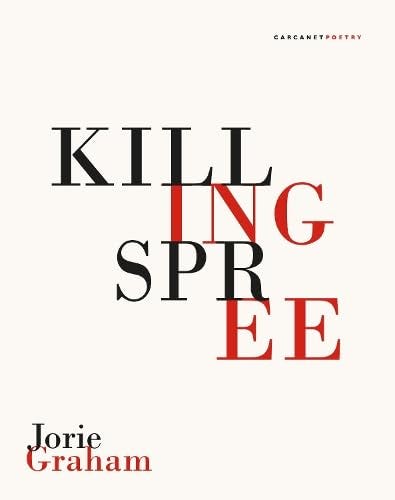
Increasingly this has centred on her ecocritical concerns about the environment and climate change. One might say that, as the books have gone on (from 2008’s Sea Change to 2023’s To 2040), the overriding feeling conveyed is one of urgency and acceleration, of a concerted effort to communicate the severity of our situation before time runs out and even to address a future generation (as in To 2040) in the hope that we can still reach such a year. Graham’s latest collection Killing Spree, which came out early this summer, continues this tone of emergency in shorter, sparer lines which assert a terser, more direct form of poetic redress.
In her Paris Review interview of 2003, discussing how she wrote the poems in Never (2002), Graham speaks of how she moved towards trying to write “in real time” and “en plein air before nature, porting it rather than reporting it, if you will”. These strategies have an ecopoetic intention at their heart, an “attempt to enact the time in which it takes to see the thing, the time in which that seen thing is living and constantly changing” in terms of “the rate of (species) extinction [that] is estimated at one every nine minutes” (Graham, 2003). This sense of heightened immediacy and simultaneity (“multiple things happening at once”) comes across in many of the late period poems, often reinforced by their irregular lineation and spatial dynamics across the page.
The poem ‘Futures’ from Sea Change is a fascinating example of Graham’s distinctive take on the ecopoem. Its form is what initially strikes the reader, the most extreme iteration yet of the alternation between short and long lines we have previously encountered in ‘The Geese’ and sections of ‘The Visible World’. The form is consistent throughout most of Sea Change: a first line from the left margin is cut across by a second line which starts halfway across the page, creating an angular, jagged pattern of line-breaks down the page, imparting a sense of unease and conflict to these anxious poems.
The title ‘Futures’ puns on the economic sense of the word (“contract for assets bought at agreed prices but paid for and delivered later”), suggesting the fiscal instability of Western societies propped up by credit and lending, an integral aspect of the capitalist political system that puts profit and expansion over environmental concerns. This connotation abuts against a second sense: the future of the natural world, both in the immediate time frame of seasonal change (from midwinter to an anticipated spring) and in the broader foresight of a deteriorating ecosystem impacted by climate change and pollution. The two have become inextricably linked in the poet’s mind: as she catches “the imagined fragrance” of what we later learn to be a lily-of-the-valley flower, this leads to a projected vision of natural disaster:
what
pandemonium, blur of spears roots cries leaves master & slave, the crop destroyed,
water everywhere not
drinkable, & radioactive waste in it, & human bodily
waste
References to everyday occurrences such as a parent-teacher meeting and lower backpains speak of the everyday reality that continues in spite of everything but ultimately too is under threat. As Isabelle Galleymore suggests in her reading of the poem: “This lulling familiarity then jars with the descriptions of meteorological catastrophe and cannibalistic activity, provoking a shocking recognition of change.” (Galleymore, 2020 )
In a beautiful passage provoked by the sight of a swan “on the dying river”, Graham seems to be restating her role as an ecopoet affirming the presence (and indeed survival) of other living creatures in a way that honours the immanent, non-Transcendental deity we glimpsed in ‘The Visible World’:
yes on my lips – the yes – I touch it again, I
begin counting, I say one to the swan, one,
do not be angry with me o my god, I have begun the action of beauty again, on
the burning river I have started the catalogue.
The poem culminates in a finely-balanced crescendo of what Galleymore calls “sensorial juxtapositions”, a blurring of its different themes and time frames. The smell of the future has morphed into the “sweet strange /smell” of money, mingling with the aroma of spring flowers and “pondwater” (“everywhere not drinkable”). What will be left of the natural phenomena of spring if the politics of money and industrialisation wins out over the poet’s efforts to catalogue and hold on to what’s left of it in form and language?
This encapsulates the challenge of ecopoetry as the need to address deepening ecological crises grows ever more urgent. Is it enough to begin “the action of beauty again” by describing and cataloguing the natural world, a means of “owning it” perhaps not so distinct from the “anthropocentric” perspective which regards the countryside as tracts of private property to be exploited, rather than respecting it as something of living value in itself? As well as her other qualities, Graham is a self-aware poet with a fiercely critical insight into the responsibilities of poetry, intensely conscious that ecological crisis is the most pressingly important theme that poets need to be writing about today:
The earth said
remember me.
The earth said
don’t let go
(‘Poem’, from Runaway, 2020)
References
Bates, Jonathan. The Song of the Earth. London: Picador, 2001
Galleymore, Isabelle. Teaching Environmental Writing: Ecocritical Pedagogy and Poetics. London: Bloomsbury, 2020
Graham, J. Interviewed by T. Gardner. ‘The Art of Poetry No. 85’, Paris Review. 2003
Graham, J. The Dream of the Unified Field: Selected Poems 1974-94 Manchester: Carcanet, 2006
Graham, J. Sea Change. Manchester: Carcanet. 2008
Larkin, Peter. Encounters, Clusters, Entanglments: Horizons of ‘Heavy Hope’ in Recent British and Canadian Ecopoetry in Tears in the Fence 83, Spring 2026
Mambrol, Nasrullah. ‘Ecopoetics’ on Literary Criticism and Theory website at www.literariness.org
Penn, Victoria. ‘Bodies of Water: The Ecofeminist Water Poetry of Jorie Graham and Alice Oswald’ Durham theses, Durham University. http://etheses.dur.ac.uk/14673/. 2022
Rueckert, W. ‘Literature and Ecology: An Experiment in Ecocriticism’. Iowa Review, 9(1): 71–86. 1978
Shoptaw, John. ‘What is Ecopoetry?’ in Poetry Chicago, 2016